
Generative Toolsets
Produce meshes, textures, and landscapes from text or reference images — powered by ComfyUI, Tripo3D, Meshy, and more. Procedural terrain noise and real heightmap import bring landscapes into the same one-click pipeline.
For Unreal Engine 5.8
MIA wires local and cloud AI models directly into UE5 — generate meshes, textures, sprites, terrain, Gaussian Splats, animation, and logic, or drive a live Blender session, without ever leaving the editor. Prefer working outside the engine? MIA Studio is the same generation pipeline as a standalone desktop app.
Fab creator account accepted — launching on Fab Marketplace soon
Capabilities
Every toolset runs natively inside the Unreal Editor — no context switching, no external round-trips.
Produce meshes, textures, and landscapes from text or reference images — powered by ComfyUI, Tripo3D, Meshy, and more. Procedural terrain noise and real heightmap import bring landscapes into the same one-click pipeline.
A dedicated Pixel Lab surface — text-to-sprite, style-referenced generation, multi-frame animation, and masked inpainting, with a crisp nearest-neighbor resize control for whatever comes back.
Generate a splat from one photo, or train one locally from your own footage. Import from Postshot, Scaniverse, Polycam, and more.
Not found on any other Fab pluginText, a starting image, or reference frames into a real video clip — MiniMax H3 (Hailuo 3.0): up to 2K, 4–15 seconds, with native audio in a single pass. In the editor, in MIA Studio, and metered through MIA Cloud.
Generate baseline motion from a text prompt, import real BVH mocap, and train a neural locomotion controller — all in one tab.
Niagara-driven fluid and particle effects, tunable straight from the panel — no manual system graph wiring required.
Talk to Claude, OpenAI, Gemini, Grok, MiniMax, DeepSeek, local Ollama/LM Studio models, or your own OpenAI-compatible endpoint from a dockable chat panel with live streaming. Ask it to read a real webpage, PDF, or video transcript and it will — not just a search snippet.
Turn it on and MIA can move your real mouse, click, type, and take a screenshot to show you exactly what to do — off by default, and every action still needs your approval.
Let MIA's chat script a running Blender session directly — create, rig, and material objects in real time, not just import/export.
Not found on any other Fab pluginChain generation and automation nodes on a graph canvas, pick from 17 ready-to-run starter templates, or let an orchestrator agent build the workflow for you.
Core toolsets ship as first-class native plugins — full API parity, no Python bridge, no runtime dependency overhead.
Run entirely offline with local models where it counts — cloud providers are opt-in, never required.
Every generated texture, mesh, sprite, and sound in one searchable, filterable browser — no more hunting across toolsets for what you already made.
One install from the Fab Marketplace once launched. No manual builds, no missing dependencies — it just works.
In The Editor
Live captures from a real Unreal Engine 5 project running MIA — no mockups, no staged renders.
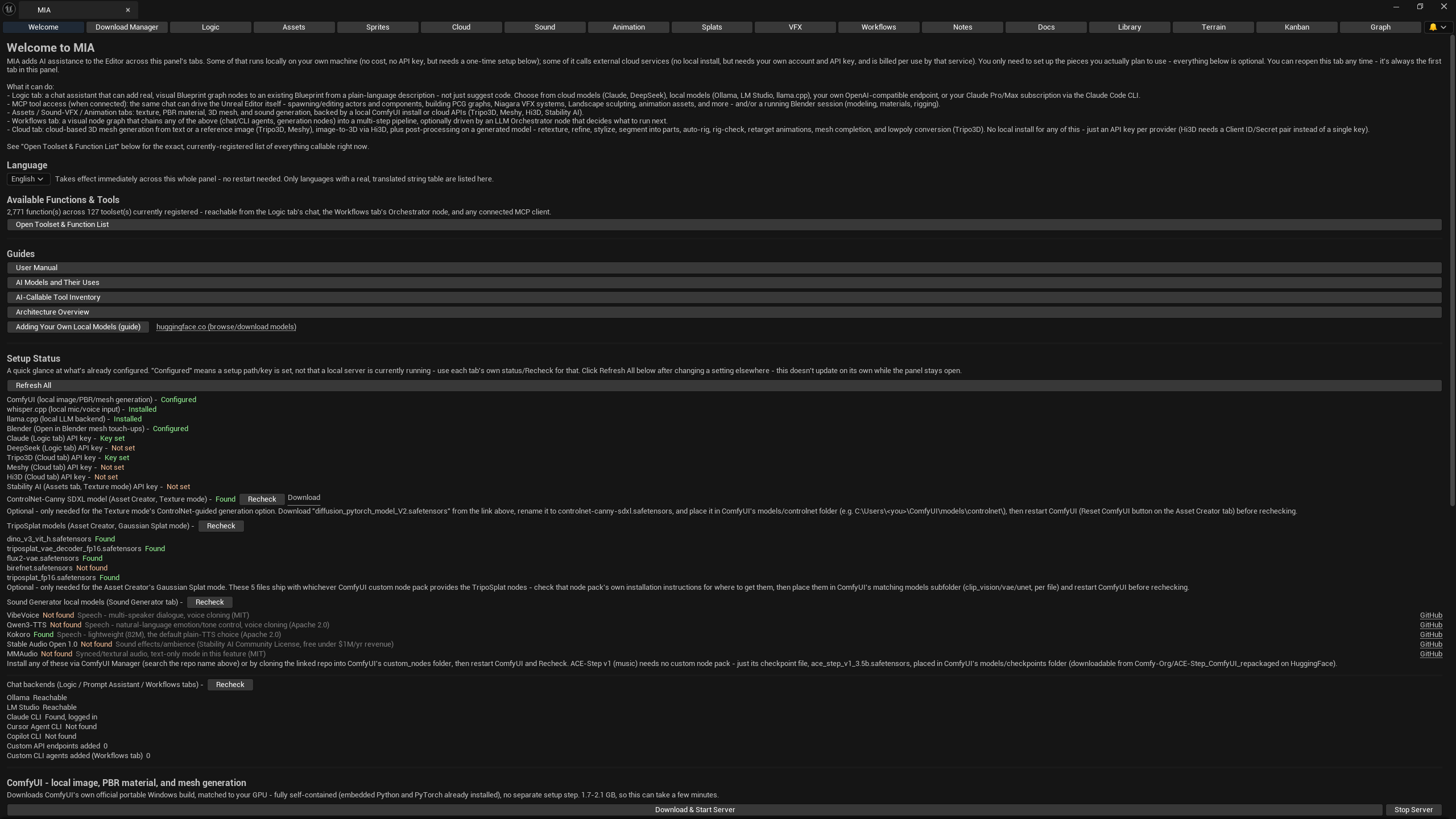
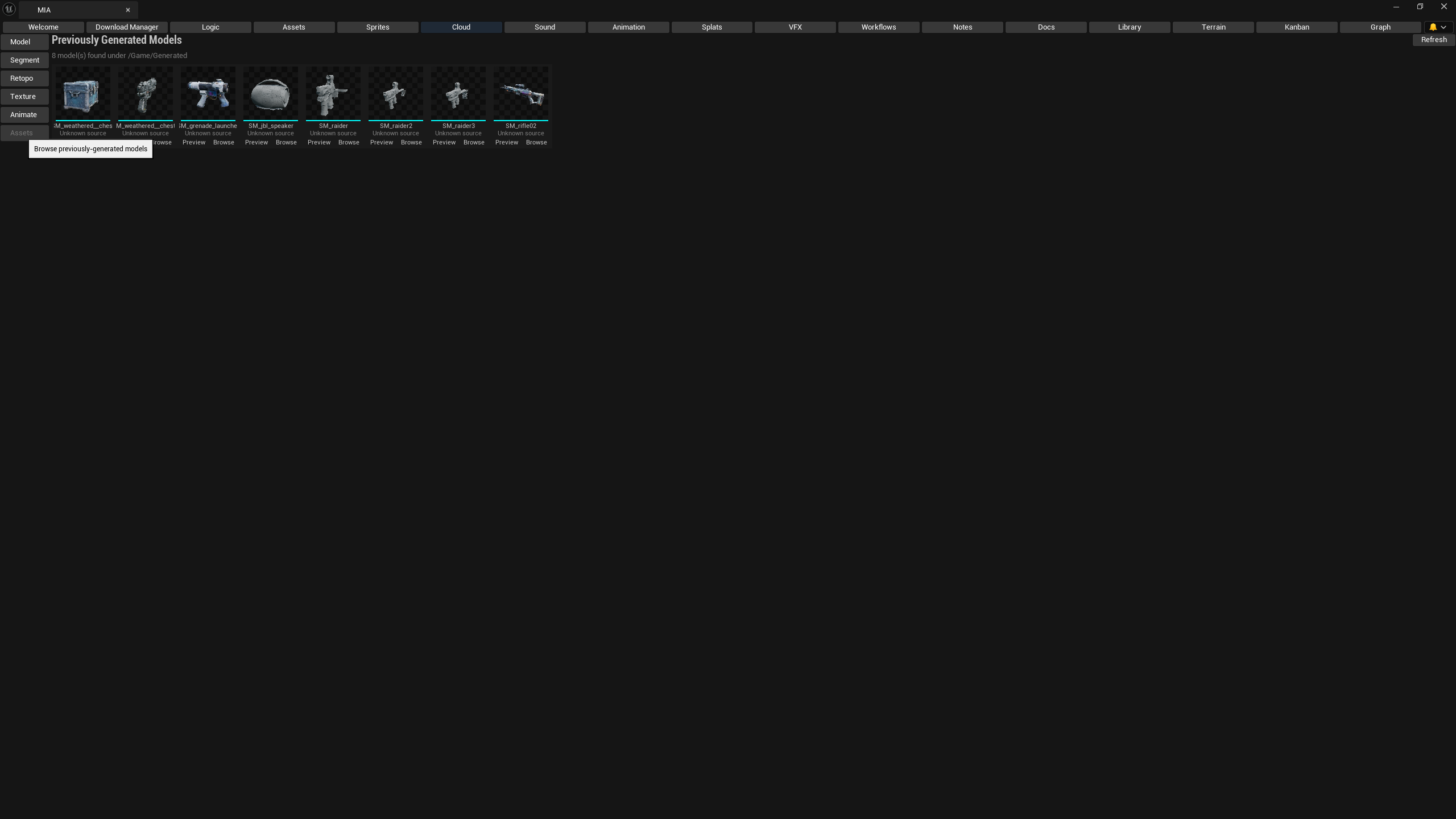
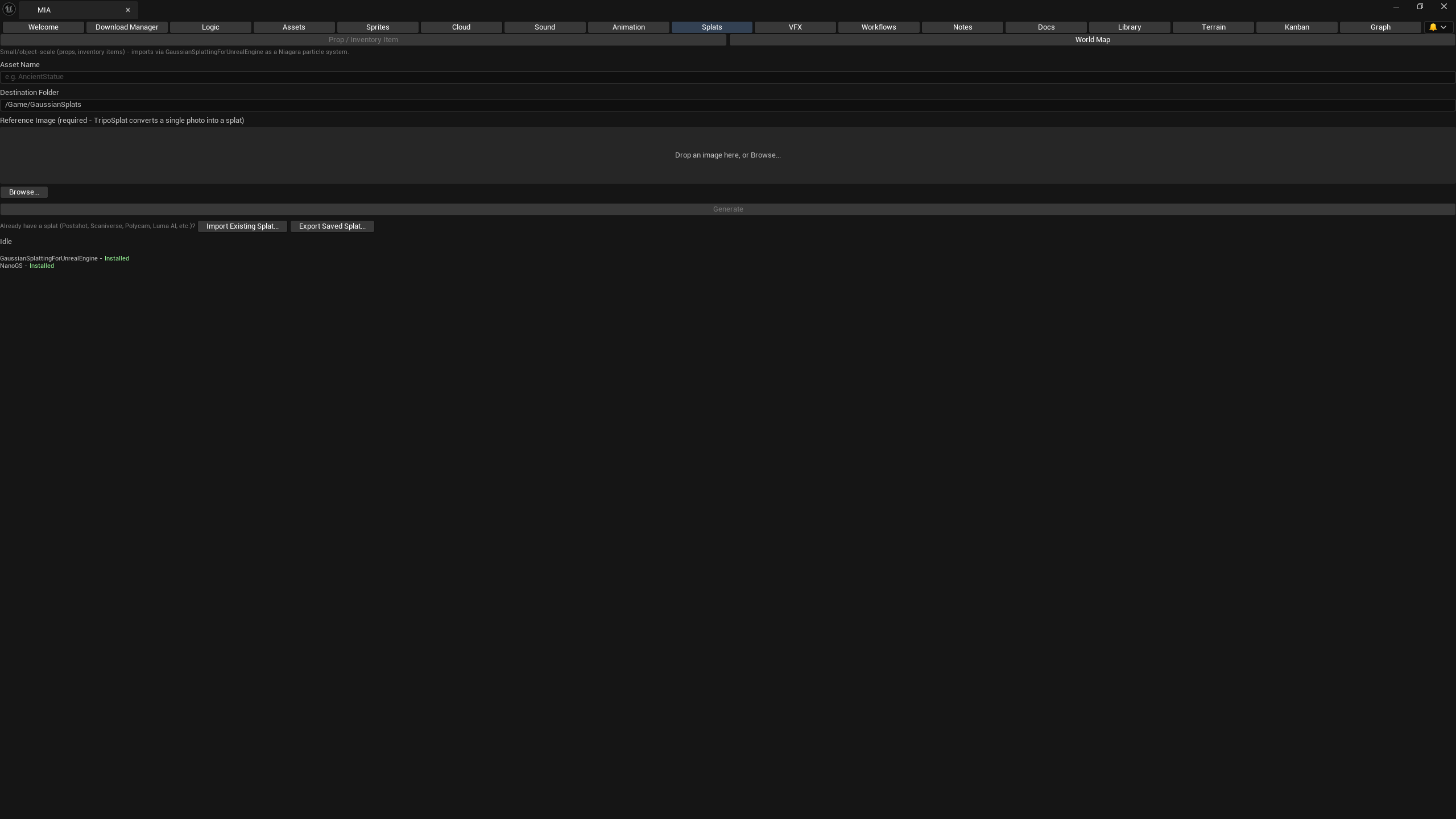
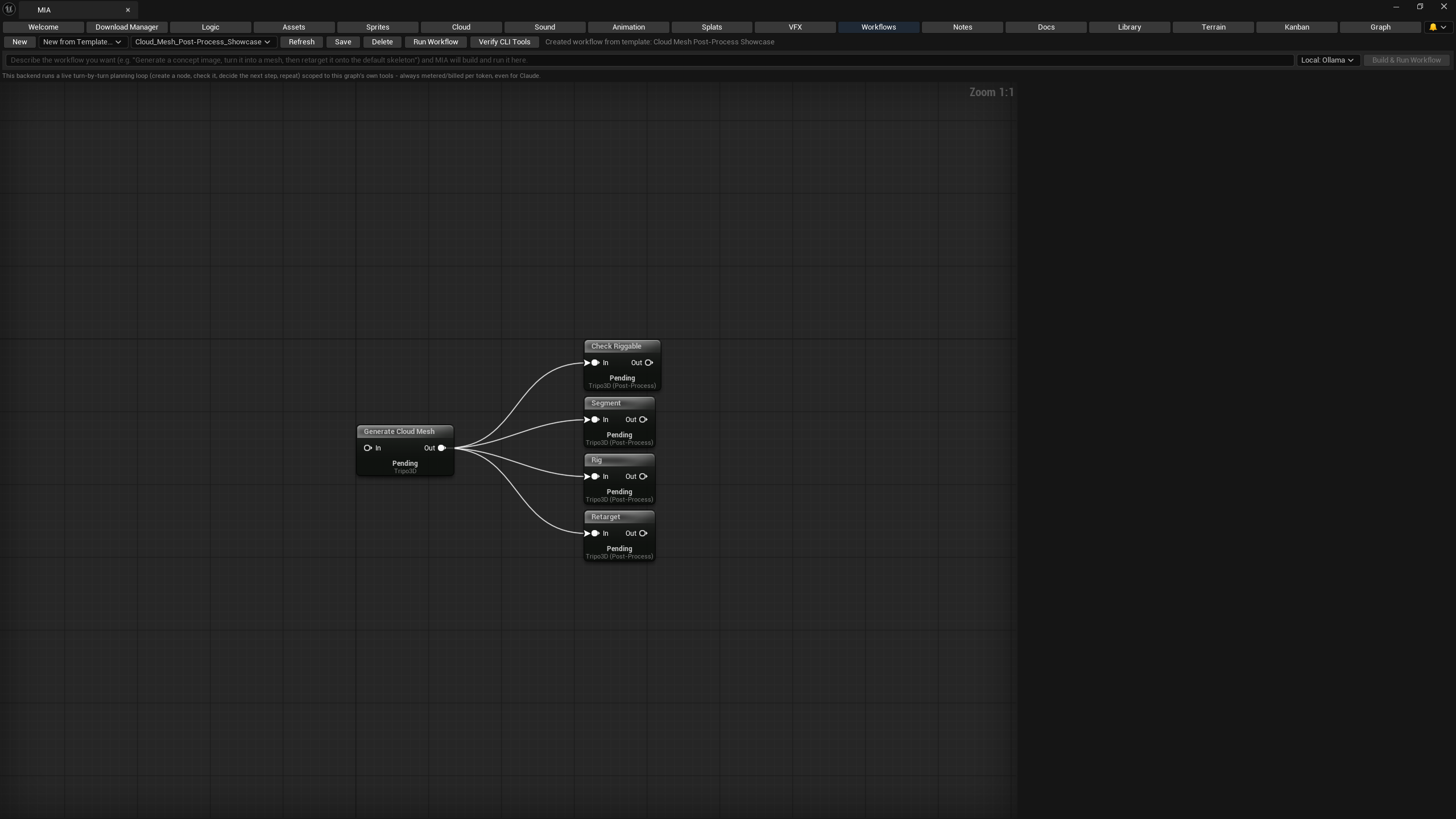
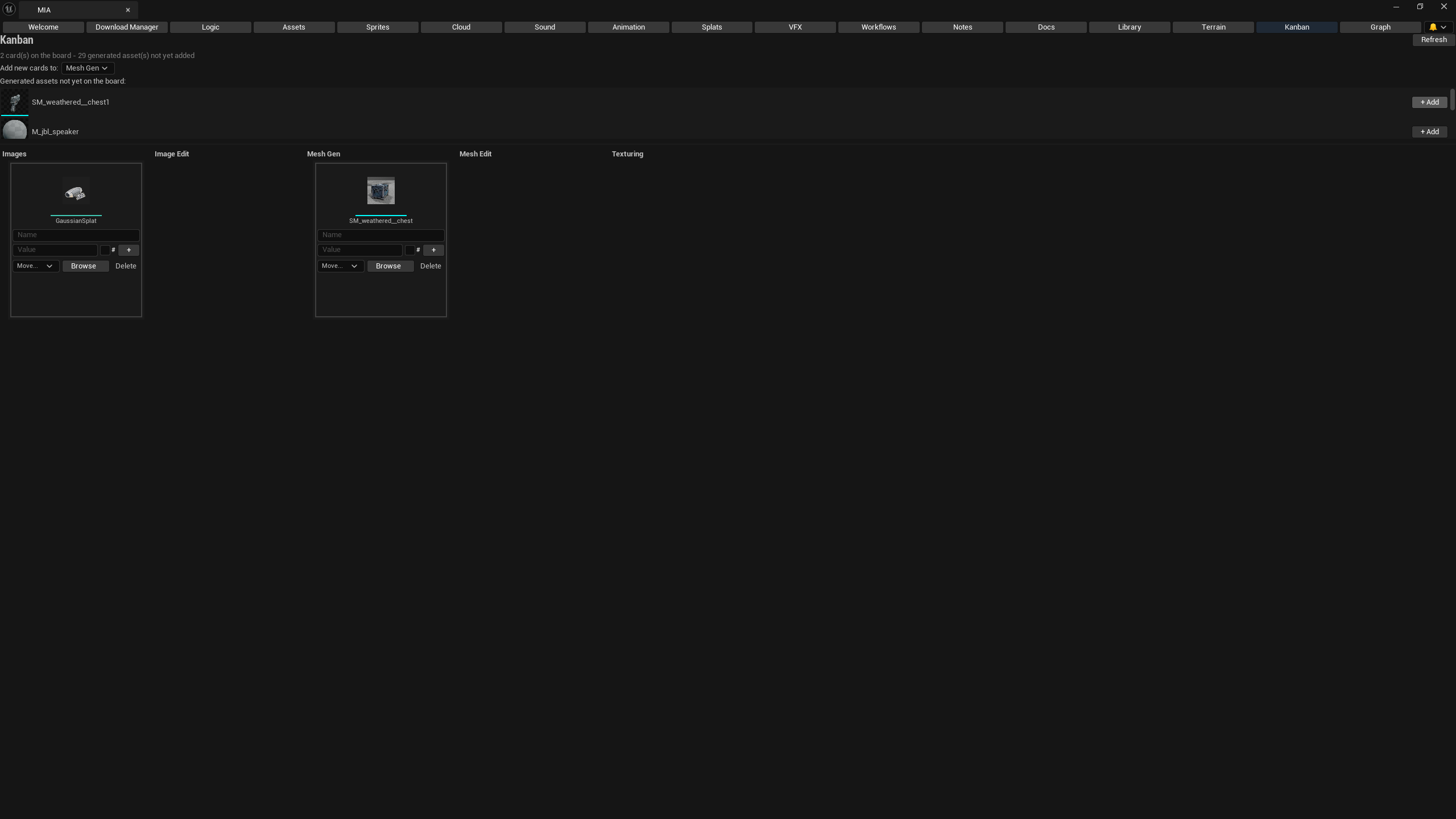
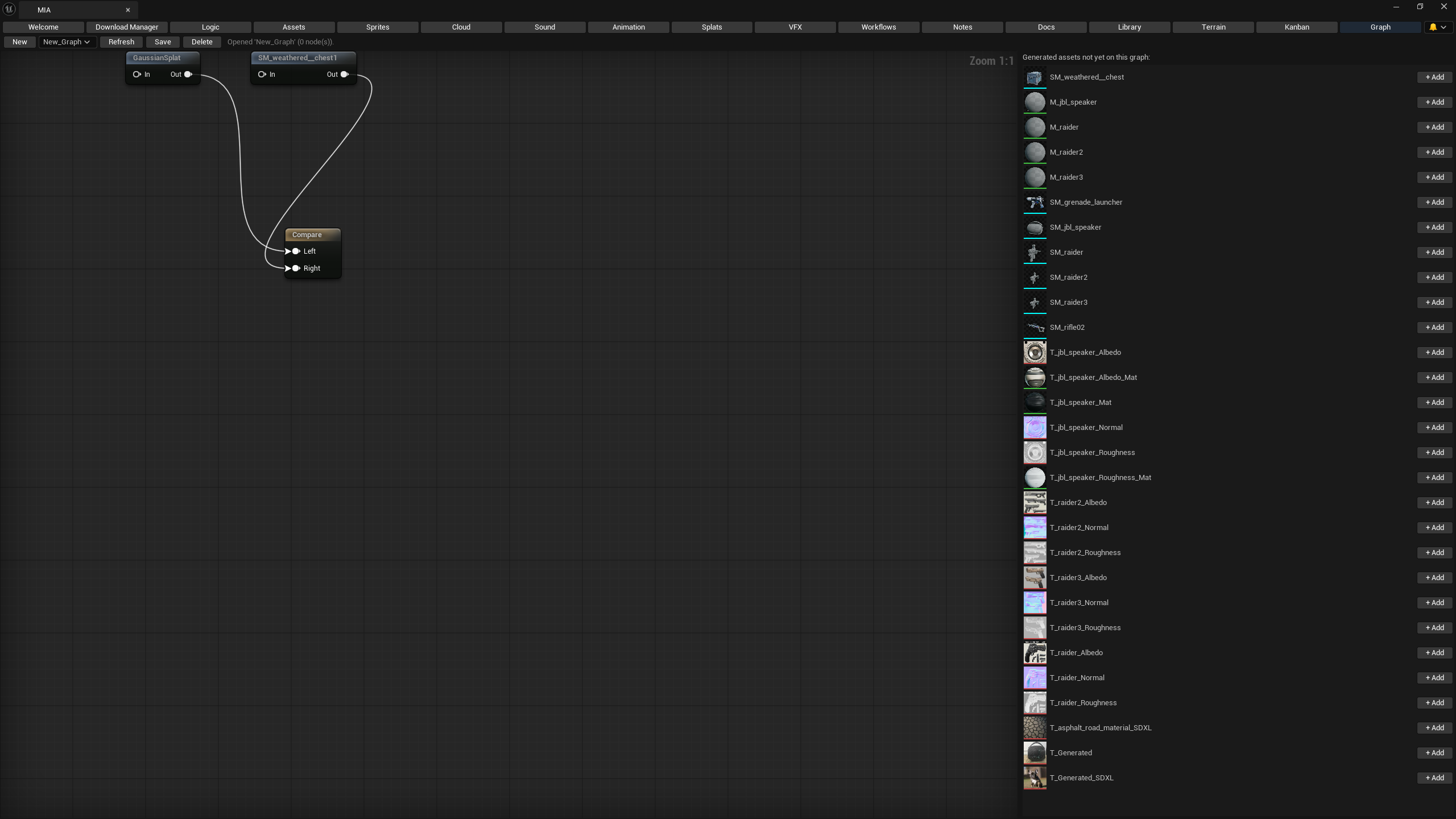
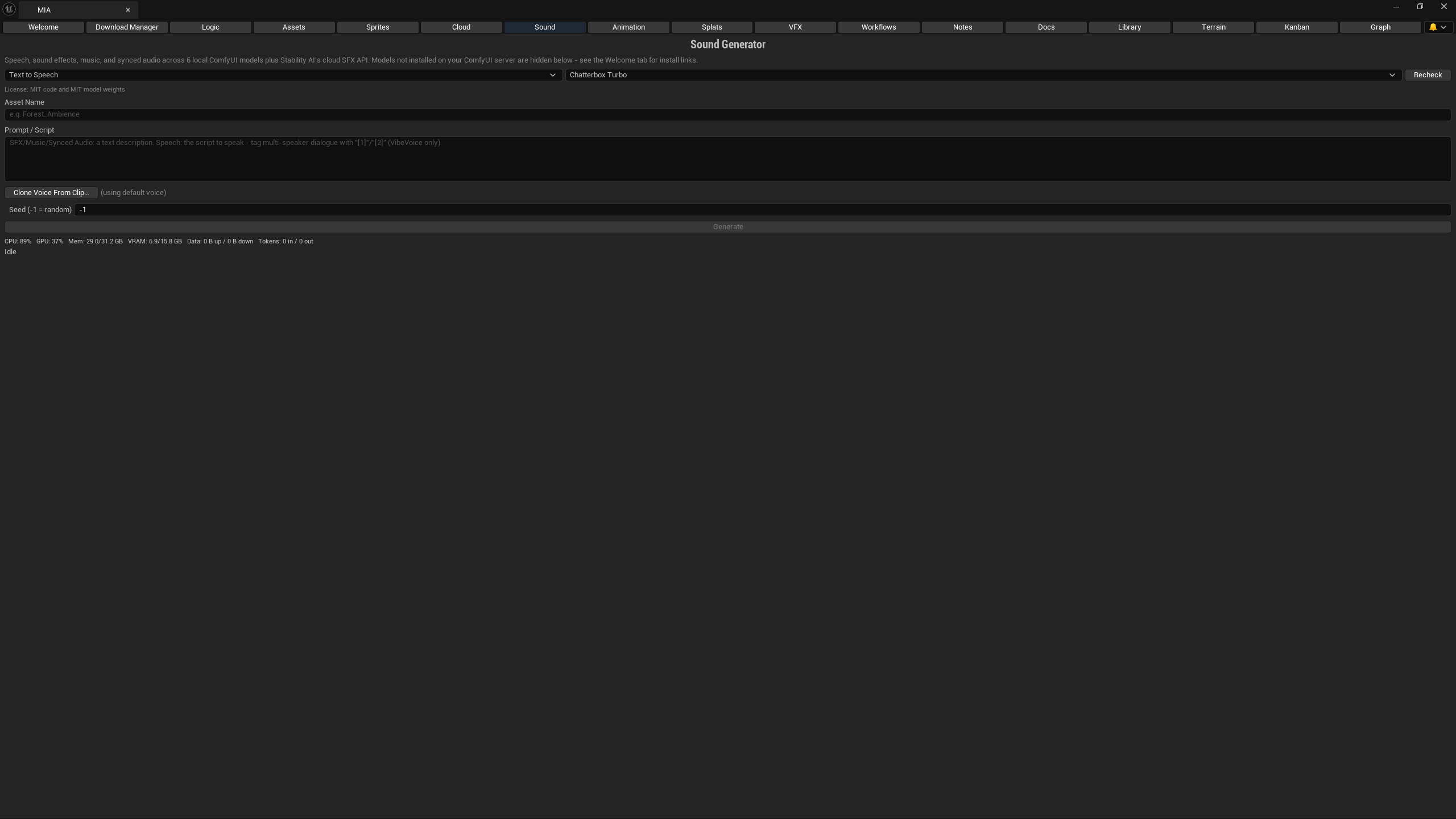
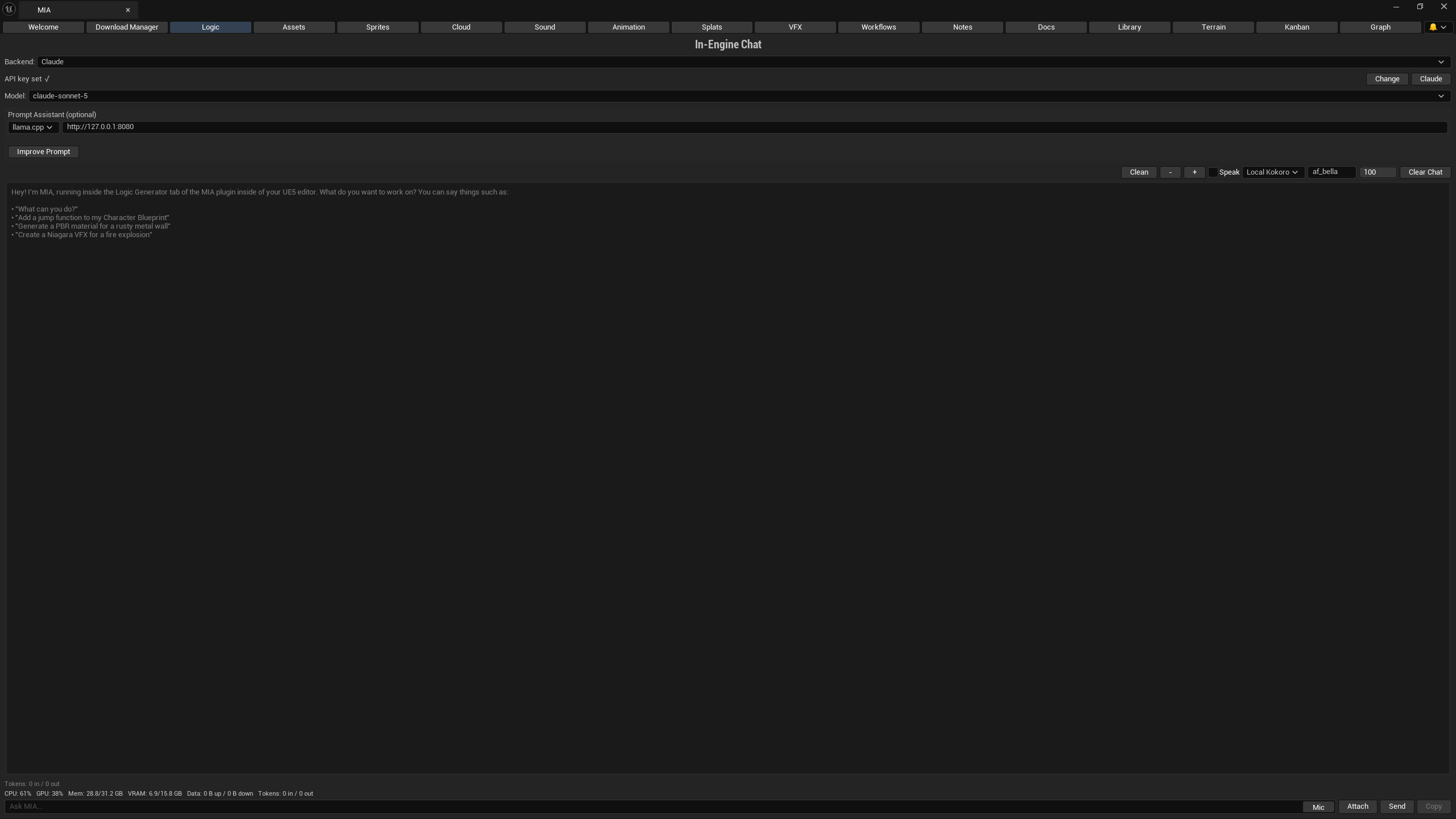
Desktop Companion
A standalone desktop app for pre-production and asset generation before anything touches a project file — generate, iterate, and organize, then send finished assets straight into Unreal, Unity, Godot, or a live Blender session. MIA Studio Lite brings the full generation, drawing, and a genuine mesh editor to Android — including on-device chat, vision, and image generation that need no server at all — plus notes, Terrain/World building, and a node-graph Workflow tab, fully offline-capable with no desktop app required.
Textures, PBR materials, meshes, Gaussian Splats, and pixel-art sprites — the same local ComfyUI and cloud providers as the Editor plugin, with side-by-side multi-model comparison. The node graph has its own starter-template gallery too, including real multi-step chains.
A Clip Studio / Krita-class 2D editor built in: raster and re-editable vector layers, groups, clipping masks, non-destructive filter/adjustment layers, layer styles (shadow / stroke / glow), paint-editable transparency masks, and 16 blend modes. Brush engines — round, textured, spray, smudge, blend, sketch, hatching, bristle, clone, and custom stamps that import .abr/.gbr/.gih/Krita tips — with a pressure curve, stabiliser, QuickShape, and mirror + radial symmetry. Painting assistants (ruler, parallel, vanishing-point, 2-point perspective, ellipse) that snap your strokes. Fill, gradient, shapes, Levels & Curves, a full filter gallery, magic-wand selections, perspective transform, a pen tool, and a frame-by-frame animation timeline with onion skin and GIF / webm / spritesheet export. Wide-gamut Display P3, linear-light compositing with soft-proofing, CMYK soft-proof, autosave, palette management (.gpl/.ase), and PSD / OpenRaster / TIFF / SVG / 16-bit PNG import & export.
Text-to-speech with real voice cloning (F5-TTS, Qwen3-TTS, VibeVoice), sound effects, and music generation — local and free by default, with ElevenLabs available when you want cloud quality, transcription, or dubbing into another language.
Connect to Unreal, Unity, Godot, or Blender's own MCP server and push a finished asset straight into a running session — plus one-click BlenderMCP addon setup, no manual install.
Claude, OpenAI, Gemini, Grok, MiniMax, DeepSeek, local Ollama/LM Studio, your own OpenAI-compatible endpoint, or your Claude Code CLI login — with MCP tool-calling into every capability the app has, real webpage/PDF/video-transcript reading, and voice in/out.
MIA remembers facts across sessions and brings them into every new chat automatically. Turn on Web Control and she can drive a real embedded browser tab — navigate, click, and read pages — right alongside your project.
Turn it on in Logic or Learn and MIA can move your real mouse, click, type, and take a screenshot to show you exactly what to do — off by default, and every action still needs your approval.
Freeform notes per project, with one click to reorganize rough thoughts into an ordered checklist via AI — no detail dropped, just restructured.
Every project is a real, Git-syncable folder on disk. Bring your own local models where it counts — cloud providers are opt-in, never required.
Android
Everything that makes MIA Studio useful, running natively on a phone or tablet — on-device chat, vision, and image generation need no server and no Wi-Fi at all.
Coming soon to Google Play
Chat, vision, and image generation run locally on the device itself — whisper.cpp voice input, an on-device vision model, and stable-diffusion.cpp for offline image generation, with cloud providers available whenever you want them instead.
The same Clip Studio / Krita-class layered image editor as the desktop app, tuned for touch and stylus — pressure-sensitive brushes, layers, masks, and filters on a tablet screen.
Procedural heightmaps, sculpt brushes, material-layer paint, sky, and water — the same terrain and world tools as MIA Studio, ported to run natively on Android.
Transform, cleanup, and decimate a mesh, paint PBR textures, run a cloud remesh or retexture pass, or sculpt with real boolean and brush tools — a genuine mesh editor, not just a viewer.
The same visual Workflow tab as the desktop app and the Editor plugin — chain generation and automation nodes together, right from your phone.
Bring your own storage — S3, WebDAV, Dropbox, or Google Drive — and keep projects, brushes, and references in step between your phone and MIA Studio on desktop.
Quick Start
Install from Fab, enable the plugin, and open the MIA tab.
From the Fab Marketplace, add MIA to your project, then enable it in the Plugins window.
# In your project's Plugins folder, or via Fab's "Add to Project"
Edit > Plugins > Search "MIA" > Enable > Restart EditorFind it under the Window menu, then dock it wherever fits your layout.
Window > MIA > "Open Panel"Pick a local backend like Ollama, or add your own API key for a cloud provider.
// Settings > MIA > Providers
provider: "ollama",
model: "qwen2.5-coder:7b",
endpoint: "http://localhost:11434"Type a prompt in the Workflows tab and run it against a generation node.
# Workflows tab
prompt: "low-poly wooden crate, game-ready"
node: Generate Mesh → Import to Content BrowserMIA's Fab creator account has been accepted — the listing itself isn't live yet. Follow along for the real launch date and a first look before it drops.
Release news, dev-log drops, and early looks at MIA — straight to your inbox.